Supporting article · 8 min · Updated 30 Aug 2026
Two-hand tapping fundamentals
Quick answer
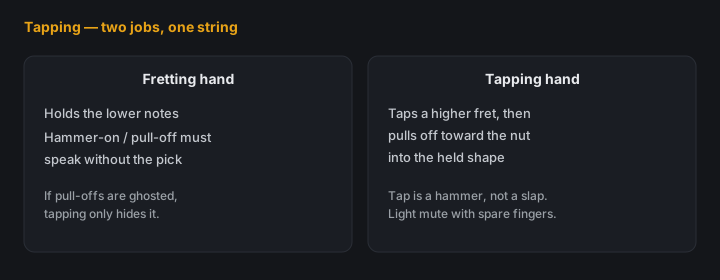
Tapping is not a third technique you sprinkle on a weak left hand. The tapping finger hammers a higher fret; it then pulls off toward the nut so a held fretting-hand note speaks. If that pull-off is quiet, the lick is a click, not a line.
Problem statement
Players copy a three-note tap shape at performance tempo and get slaps, open-string noise, and a tapped note that is louder than everything around it. The missing skill is usually legato in the fretting hand, plus a mute from the spare fingers of the tapping hand.
Step-by-step guidance
- Prove the pull-off. On one string, hammer-on and pull-off a two-note shape with no pick and no tap. Every note the same length. If this fails, stop and use legato first.
- Add one tap. Fret a lower note. Tap a higher fret on the same string with the index or middle of the picking hand. Pull off toward the nut so the lower note rings. One tap, one pull-off, repeat.
- Match volume. The tap is usually too loud. Lighten the hammer until it matches the pull-off. High gain will lie to you; turn it down to diagnose.
- Mute the unused strings. Side of the tapping-hand palm or spare fingers. A tapped lick with four ringing strings is noise.
- Three-note cell. Lower fret / pull-off / tap — or tap / pull-off / pull-off. Loop one bar with the 1-bar protocol.
- Move the cell only after it is even. Changing strings too early reintroduces the problems in string crossing, plus new mute work.
Common questions
- Index or middle finger to tap?
- Whichever stays relaxed and can pull off toward the nut. Consistency beats a borrowed famous player’s choice.
- Do I need a special pick grip?
- Park the pick against the index with the thumb, or tuck it. Do not invent a mid-lick pick flip until the notes exist.
Related reading
Legato · Targeting · Speed · Techniques hub · Lead hub
Sources: standard two-hand tapping pedagogy. Not a motion-capture study. Updated 30 Aug 2026.