Sweep picking fundamentals
A sweep is one pick stroke that travels across two or more strings while your fretting hand rolls, so only one note rings at a time. If two strings ring together, you strummed. Start on three strings. When the notes blur, stop. Don't add more strings to hide it.
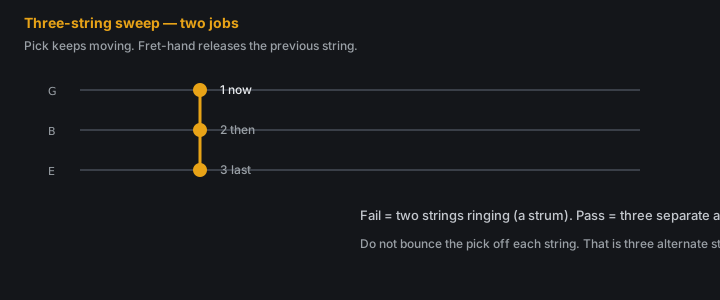
Sweep vs strum vs alternate picking
A strum lets neighboring strings ring together. A sweep uses a similar pick path, but each fretting finger lifts off as the pick moves on, so the previous string goes quiet. Alternate picking reverses direction on every note. Economy picking on scales is related (you keep going in one direction when the next note is on the next string), but it isn't an arpeggio roll. More in alternate vs economy picking.
The pick doesn't bounce once per string. If it does, that's alternate picking in disguise.
The roll is the hard part
Everyone over-practices the pick path. The real skill is in the fretting hand. Fret three notes of a minor or power-chord shape on the G, B and high E strings. As the pick arrives on the second string, the finger on the first string lightens until that string goes dead. Same for the third. If you hear a chord, your release is late.
Practice the roll with barely any picking at first. Just plant and release, so you can hear the mute working.
The practice ladder
- Two-string sweep, 8th notes, with a click. Both notes the same length.
- Three strings, descending only, at a tempo where you can name each note.
- Three strings, ascending only. The roll direction flips, so treat it as a new skill.
- Down and up linked together. Still 8ths or slow triplets.
- Only now raise the tempo 4 BPM at a time, using the 1-bar routine.
Stop rule: if two strings ring as a chord, or the last note is late every time, drop the tempo or drop a string. Adding a fourth string to make it look like a sweep just teaches you to strum.
Your first sweep (tab)
Three strings, playing E, B, E (the notes of an E5 power chord). Slow 8ths: one continuous downstroke, a rest, then one continuous upstroke. Roll so only one note rings.
e |----------12----------12--------|
B |-------12----------------12-----|
G |----9-----------------------9---|
D |--------------------------------|
A |--------------------------------|
E |--------------------------------|
      1     2     3     4
      down-sweep        up-sweep
The G string at the 9th fret is E, the B string at 12 is B, and the high E at 12 is E again. Each sweep ends on E, a solid landing note over E5. If you hear a chord on the way, the roll failed. Don't add a tapped note at 19 yet. That's a separate skill: tapping.
Practical advice
Record one bar with the gain low enough to hear blurred notes. High gain flatters a sloppy roll. And make the last note of the sweep a chord tone of the riff underneath. Otherwise it's decoration with nowhere to go.
Common mistakes
- Starting with five- and six-string shapes copied from a solo.
- Picking each string separately and calling it a sweep.
- Rushing the top note because the cascade "sounds cool".
- Skipping the roll and hoping distortion will separate the notes.