Drop tunings explained: Drop D, C, B and A
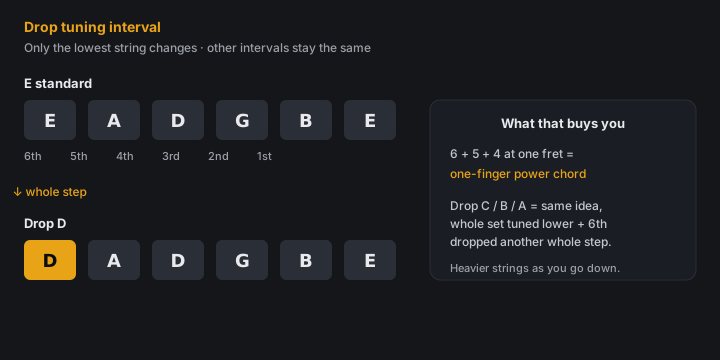
A drop tuning lowers only your lowest string by a whole step. Drop D takes you from E A D G B E to D A D G B E. Now the lowest three strings form a power chord you can play with one finger, and your open low note is a step heavier. Lower drop tunings (C, B, A) work the same way, but they need heavier strings and a setup, or the low string turns to rubber.
What drop tuning actually changes
In standard tuning, a power chord on the two lowest strings takes two fingers on two different frets. Drop the sixth string a whole step and the root and fifth line up on the same fret. One finger, flat across the strings, and you've got a power chord. Slide that finger and you've got a riff.
That's why drop tunings took over heavy music. Fast chord changes on the low strings get easy, you can add the octave with the same finger, and the open string gives you a deeper note to chug on. The trade-off is string tension. Every step you drop takes tension away, and a loose string sounds flabby and won't mute cleanly.
How to tune to Drop D in 30 seconds
- Start in standard tuning.
- Play the open D string (4th string) and let it ring.
- Lower the low E string while you play it at the 12th fret, until that note matches the open D exactly. The wobble between the two notes slows and disappears when they match.
- Check it: the open low string and the open D string should sound the same note an octave apart.
A clip-on tuner works too. Just set it to chromatic, because some tuners in "guitar" mode expect an E on the sixth string.
Drop tuning chart
Every tuning below keeps the same shapes. A one-finger power chord at the 3rd fret is still a one-finger power chord. Only the pitch moves.
| Tuning | Low to high | How to get there | Common starting gauge* |
|---|---|---|---|
| Drop D | D A D G B E | Drop the low E one whole step | 10–46 is fine |
| Drop C# | C# G# C# F# A# D# | Tune everything down a half step, then drop the low string a whole step | 10–52 |
| Drop C | C G C F A D | Tune to D standard, then drop the low string to C | 10–52 or 11–52 |
| Drop B (6-string) | B F# B E G# C# | Tune down a step and a half, then drop the low string a whole step | 12–56 or a heavy-bottom set |
| Drop A (6-string) | A E A D F# B | Tune down two and a half steps, then drop the low string | 13–62, or a baritone |
| Drop A (7-string) | A E A D G B E | Drop the low B of a standard 7-string a whole step | Low string around .062–.064 |
*Starting points for a standard 25.5" scale guitar. Shorter scales (like 24.75") need a bit heavier, baritones a bit lighter. If the low string feels floppy or goes sharp every time you pick it, go heavier.
Not every heavy band drops the low string. Plenty of thrash, black metal and classic metal stays in E standard, Eb or D standard, and gets the weight from palm muting and tone instead. Drop tuning is a tool, not a requirement.
Riffs in Drop D (tab)
Tune your sixth string down to D. These are original shapes to get the feel of one-finger power chords, not a song.
Bar 1: D5 to F5 to G5, palm-muted 8ths. Your finger slides, and your palm stays put.
Drop D
PM  * * * * * * * *
e |----------------|
B |----------------|
G |----------------|
D |----------------|
A |0-0-3-3-5-5-3-3-|
D |0-0-3-3-5-5-3-3-|
   D5  F5  G5  F5
Bar 2: same roots, now with the octave on the D string. One finger covers all three strings. If the top note comes in late, you rolled into it instead of planting all three at once.
Drop D
e |----------------|
B |----------------|
G |----------------|
D |0-0-3-3-5-5-3-3-|
A |0-0-3-3-5-5-3-3-|
D |0-0-3-3-5-5-3-3-|
In standard tuning those shapes need two or three fingers. That's the whole point. In Drop C or Drop B the fret numbers stay exactly the same, and the riff just sounds lower. For the muting side, see palm muting. For fast 8ths on the low string, see downpicking.
Strings and setup: don't skip this
Dropping tension changes how the guitar plays. Here's what usually happens and what fixes it:
- The low string flaps and buzzes. Too little tension. Go up in gauge.
- Chugs sound blurry and the note goes sharp when you pick hard. Same cause. A heavier low string holds pitch under a hard attack.
- Chords up the neck sound out of tune. The intonation needs resetting after the gauge change.
- The strings sit higher or lower than before. The neck relief changed. A truss rod tweak fixes it.
Don't put 9s on a guitar in Drop A and blame the guitar. More on this in strings and setup for metal tunings.
Common questions
What is drop tuning?
Drop tuning means lowering only the lowest string of the guitar by a whole step while the other strings keep their normal intervals. Drop D (D A D G B E) is the most common. It lets you play power chords on the lowest strings with one finger and gives you a lower, heavier root note.
What is Drop A tuning?
On a 7-string, Drop A lowers the low B to A: A E A D G B E. On a 6-string, Drop A is A E A D F# B, which needs very heavy strings or a baritone guitar to stay in tune and feel tight.
What string gauge do I need for drop tuning?
Drop D works fine on normal 10–46 strings. For Drop C, most players go to 10–52 or 11–52. Drop B usually needs 12–56 or a heavy-bottom set. Drop A on a standard 6-string needs 13–62 or a baritone. Get a setup after any big gauge change.
Is Drop D good for beginners?
Yes. It's one string, it's easy to get in and out of, and it makes power chords easier. Just learn the standard-tuning shapes too, because most songs outside metal use standard tuning.