Supporting article · 7 min · Updated 30 Aug 2026
Pinch harmonics
Quick answer
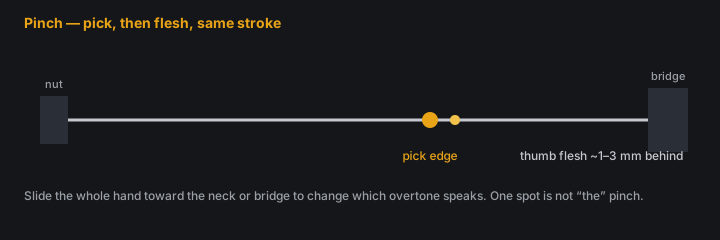
A pinch (squealie) is one stroke: the pick hits, and the thumb edge immediately kisses the string at a harmonic node. Gain helps the overtone speak. It does not create the node. Slide the whole hand along the string until a pitch jumps out, then keep that contact distance.
Problem statement
Players “dig in” harder and add distortion, then get a dead thunk or a random chirp they cannot repeat. The missing piece is location. Nodes move when you change fret, string, or pickup. See the glossary entry for the short definition: pinch harmonic.
Step-by-step
- Hold the pick so a sliver of thumb is past the tip. If the thumb never touches the string, there is no pinch. If it buries the string, there is no note.
- Fret one note. Downstroke. Listen. Start on the G or B string around the middle of the body. A dead hit means you are off the node or the flesh stayed on the string.
- Move an inch toward the neck, try again. Then toward the bridge. You are mapping nodes, not practicing a riff. When a clear overtone appears, freeze the hand relationship to the bridge.
- Same fret, same string, five repeats. If only one of five squeals, you do not have it yet. Do not add a bend until repeats exist.
- Then bend or use it as a phrase end. A pinch in the middle of a scale run is optional color. A pinch that lands on a chord tone reads as intention.
Common questions
- Does this only work with a bridge pickup and high gain?
- Bridge pickup and gain make the overtone obvious. You should still be able to hear a thin harmonic on a cleaner sound if the node is right. If it only “works” with a wall of distortion, the contact is sloppy.
- Why did the pitch change when I moved up two frets?
- The vibrating length changed. Nodes move. Hunt again. That is normal.
Related reading
Sources: standard artificial-harmonic / pinch technique. Node locations are physical, not brand-specific. Updated 30 Aug 2026.